01
People
People need health, food, education, safety, dignity, opportunity and the ability to participate in decisions that affect their lives.
17 Goals. One shared future.
Sustainable development asks one of the most important questions humanity can face: How can we improve life today while protecting the ability of future generations to thrive?
Every goal connects to another. Every action can create change.
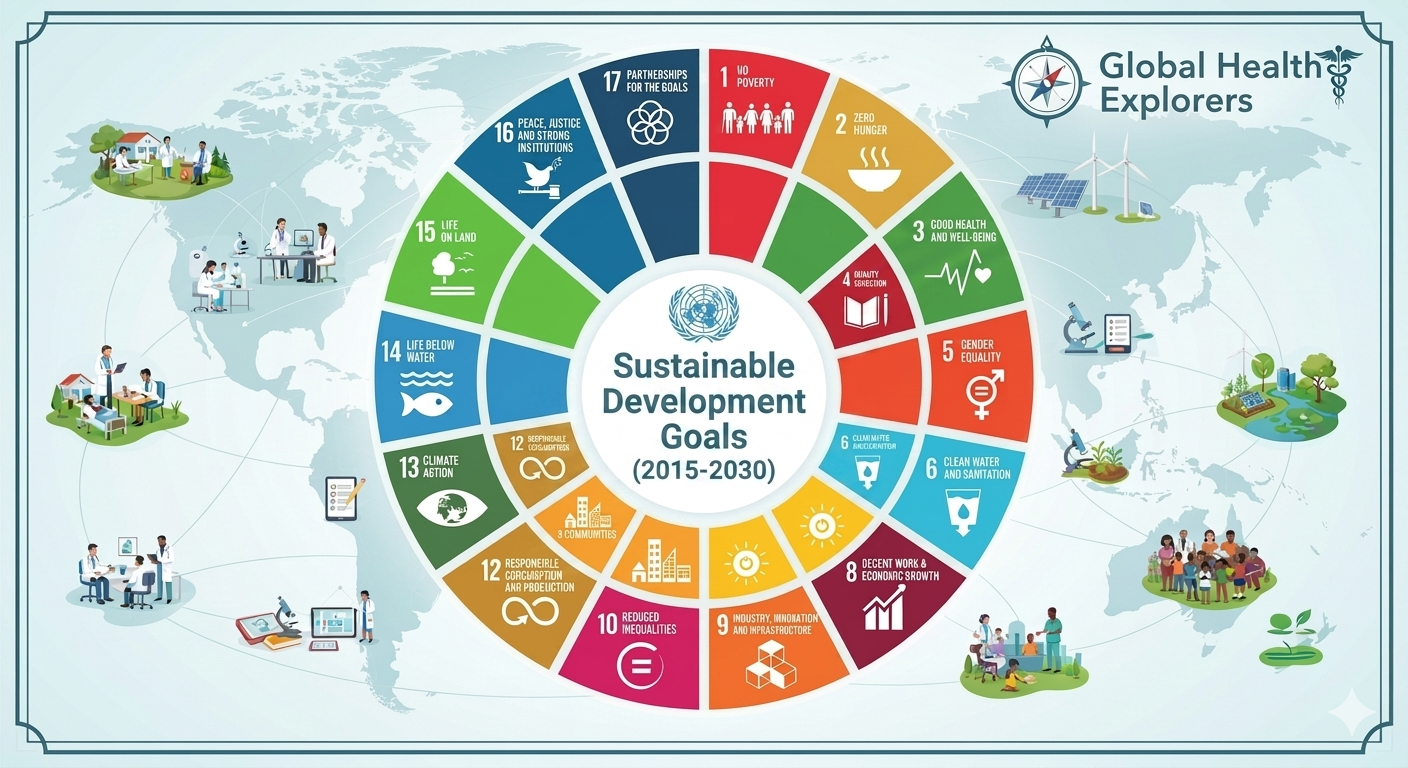
The United Nations 2030 Agenda describes sustainable development as an integrated agenda for people, planet and prosperity, supported by peace and partnership. The 17 Goals are interconnected rather than separate projects.
People need health, food, education, safety, dignity, opportunity and the ability to participate in decisions that affect their lives.
Healthy societies depend on functioning ecosystems, clean air and water, stable climates and responsible use of natural resources.
Sustainable prosperity means creating opportunities while considering whether economic activity is inclusive, resilient and compatible with a healthy planet.
Peaceful and inclusive societies require justice, trustworthy institutions, participation and respect for human rights.
No country, community or institution can solve every global challenge alone. Collaboration turns shared knowledge into shared action.
Sustainable development is not simply about planting trees, building new technologies or growing an economy. It is about considering the consequences of decisions across time, sectors and populations.
A solution that improves one outcome while creating serious problems somewhere else may not be sustainable. Systems thinking helps us look beyond the immediate result.
The SDGs provide a common framework for addressing poverty, hunger, health, education, inequality, environmental protection, peace and partnership.
Poverty shapes access to food, housing, education, health and opportunity.
Food security, nutrition and sustainable agriculture influence lifelong health.
Health is both a goal in itself and a foundation for human development.
Education builds knowledge, opportunity, agency and human capital.
Equality and empowerment affect health, education, safety, income and participation.
Safe water and sanitation are fundamental to health, dignity and resilient communities.
Energy access affects households, health, education, productivity and climate.
Work, income, safety and social protection shape living conditions.
Resilient infrastructure and responsible innovation can expand access and opportunity.
Development is stronger when opportunities and resources are not systematically restricted.
Housing, transport, air quality, safety and planning influence urban health.
What we produce, purchase, use and discard affects health, resources and ecosystems.
Climate change affects health, food, water, livelihoods, migration and ecosystems.
Healthy oceans support food systems, livelihoods, biodiversity and planetary health.
Forests, soils, biodiversity and ecosystems provide essential services for human life.
Trust, accountability, justice and effective institutions support sustainable development.
Knowledge, financing, technology and cooperation help turn shared goals into action.
The SDGs are designed to be understood together. A change in one part of a system can create effects somewhere else.
Unsafe water can increase exposure to infectious disease and affect nutrition and learning.
Education can expand knowledge, skills, opportunity and the ability to make informed decisions.
Climate-related disruption can affect agriculture, food security and nutrition.
Unequal access to resources and opportunities can produce measurable differences in health and well-being.
Health is influenced by the conditions in which people are born, grow, learn, work, live and age. This means that progress on education, poverty, food, water, housing, gender equality, climate, cities and institutions can also influence health.
WHO's SDG monitoring work emphasizes the interconnected nature of health and the wider Sustainable Development Goals.
Sustainable development is not only about economic output. Human capital — including people's health, knowledge and skills — influences opportunity, resilience and long-term prosperity.
Healthy people are better able to learn, participate and adapt to change.
Knowledge and skills expand individual and community capacity.
Decent work and social protection can influence resilience and living conditions.
Strong people and systems are better positioned to withstand shocks.
Development must account for environmental and climate risks.
The future of development depends not only on what societies produce, but also on what they enable people to become.
GHE learning perspective, informed by human-capital and sustainable-development approachesSustainable-development problems rarely have one cause or one solution. Follow the chain — then look for possible unintended consequences.
What could happen if the city invests in reliable public transportation, walking infrastructure and safer cycling routes?
Could the same policy have different effects for different neighbourhoods or groups?
The conditions in which people live and the resources available to them influence health and well-being. Sustainable development therefore requires attention to social, economic and environmental determinants.
What is happening in a neighbourhood?
What systems and policies shape opportunity?
What forces cross borders?
Do not simply ask whether a population is doing well. Ask whether measurable differences exist, where they occur, what may explain them, and whether those differences are changing over time.
| SDG | Development issue | Health connection | GHE question |
|---|---|---|---|
| 1 | No Poverty | Access to resources and services | How does income influence health opportunity? |
| 2 | Zero Hunger | Nutrition and food security | Who has reliable access to nutritious food? |
| 4 | Quality Education | Knowledge and life opportunities | How can education influence lifelong health? |
| 6 | Water & Sanitation | Infection prevention and dignity | Where is safe water still unavailable? |
| 10 | Reduced Inequalities | Differences in opportunity and outcomes | Which groups experience measurable gaps? |
| 13 | Climate Action | Heat, air, food, water and disasters | Which health risks change as climate changes? |
| 16 | Peace & Institutions | Trust, safety and effective systems | How do institutions influence health? |
| 17 | Partnerships | Shared knowledge and capacity | Who needs to work together to solve the problem? |
Sustainable development becomes meaningful when learners move from knowing about a problem to understanding evidence and considering responsible action.
Select one SDG.
Find a meaningful indicator.
Look across places or groups.
Explore possible causes.
Propose a responsible response.
Ask what could happen next.
NextGenU provides open-access learning resources and includes systems-thinking approaches that connect global health, sustainable development and cross-sectoral problem solving.
This is closely aligned with the GHE philosophy: explore evidence, understand systems, collaborate across disciplines and turn knowledge into responsible action.
Explore NextGenU →These questions test understanding, connections and systems thinking — not memorization alone.
What is one change you see in your community that could support sustainable development?
Which SDGs are connected to that change?
What evidence would you need before proposing an action?
GHE encourages learners to explore authoritative, evidence-based sources rather than relying on unsupported claims.
2030 Agenda and the 17 Sustainable Development Goals.
Health, sustainable development and health-related SDG monitoring.
Human capital, resilience, poverty and sustainable development.
Open-access learning and systems-thinking resources in global health.
Source links are provided for learning and further exploration. GHE does not reproduce or replace the authoritative source material.