Classroom Integration
Bring global health questions into classroom learning, enrichment programs, clubs, independent study and interdisciplinary projects.
The health challenges of tomorrow will demand more than knowledge. They will require curiosity, critical thinking, compassion, evidence-based reasoning and a sense of responsibility toward others.
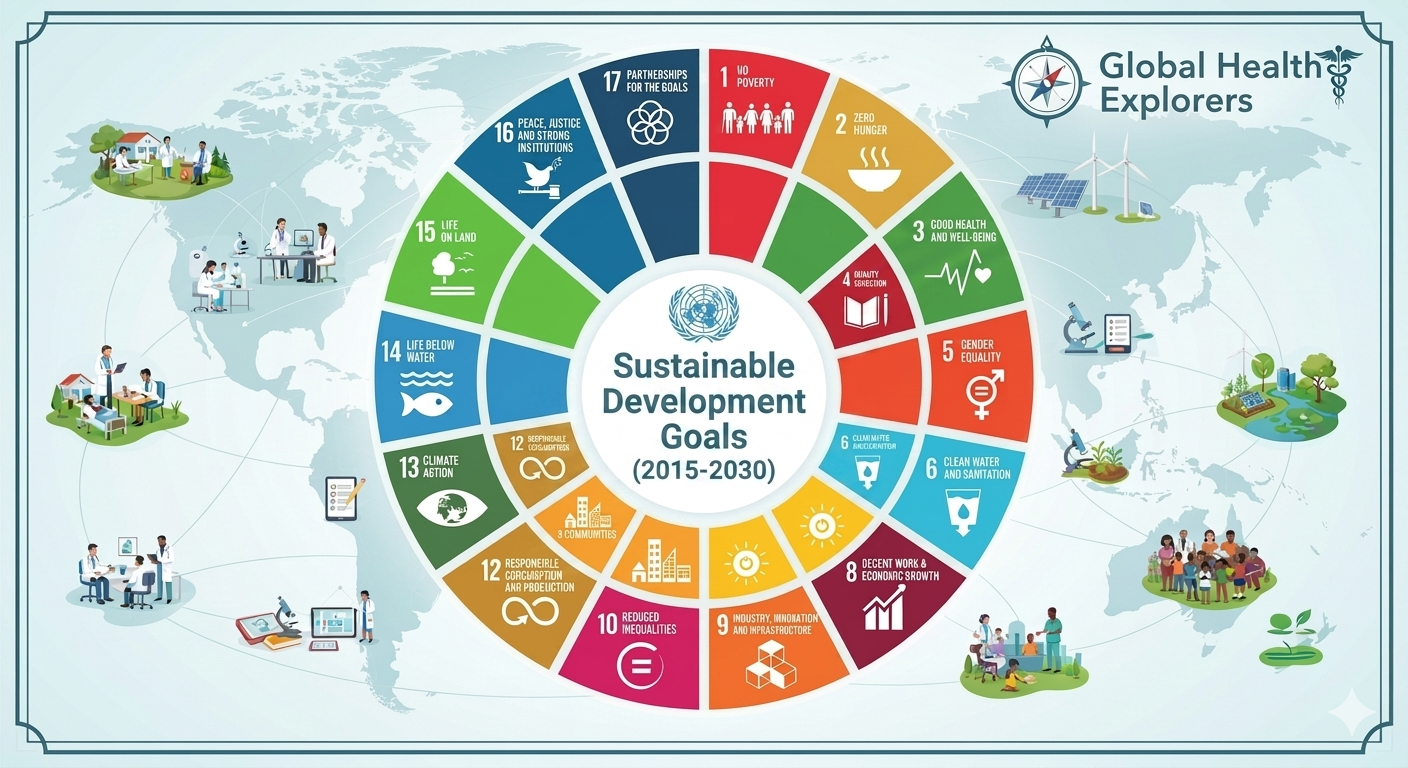
From climate change and pandemics to social determinants of health and the Sustainable Development Goals, young people are growing up in a world where health is deeply connected to our environment, communities and collective choices.
The health challenges facing the next generation cross boundaries between environment, society, health systems, technology and human development.
How do environmental changes affect human health, communities and future generations?
Explore →How can societies understand emerging threats and protect one another?
Explore →How do education, income, housing, environment, food, geography and social conditions shape health?
Explore →How are health, equity, sustainability and human development connected?
It is the intersection of people, communities, environments, systems and the choices we make together.
The next generation needs more than information. They need the ability to connect ideas, question evidence, understand complexity and act responsibly.A teacher, parent or mentor can make an enormous difference by creating the conditions in which curiosity becomes learning.
At GHE, adults are not expected to provide every solution. They can guide questions, encourage responsible inquiry, help young people evaluate evidence and support them as they develop their own ideas.
Discover how you can help →Create opportunities for inquiry, investigation and meaningful learning.
Help curiosity continue beyond the classroom and into everyday life.
Share experience, challenge assumptions and open doors to new possibilities.
GHE sees teachers as partners in learning—not simply users of educational materials.
Bring global health questions into classroom learning, enrichment programs, clubs, independent study and interdisciplinary projects.
Connect GHE with science, biology, health education, geography, mathematics, statistics, social sciences, environmental studies and computer science.
Encourage students to begin with questions rather than predetermined answers—observe, investigate, evaluate evidence and develop their conclusions.
Participate in the GHE educational platform and help students discover relevant topics, activities, challenges and opportunities.
Provide appropriate supervision and guidance as students participate in GHE learning activities, data exploration, discussions and projects.
Help students focus their questions, evaluate their reasoning, identify appropriate resources and develop thoughtful mini-proposals—while keeping the student's own voice at the centre.
Support the investigator →Introduce students to the Global Health Big Data Challenge, facilitate teams, encourage data exploration and support evidence-based investigations.
Explore GHBDC →Explore prevention, risk factors, health behaviours, health equity and the broader determinants of health.
Explore the NCD Hub →Support students in transforming questions into individual or team projects—from classroom investigations to ambitious research-oriented work.
GHE should learn from educators. Share feedback, suggest improvements, identify student needs and help shape the evolution of the platform.
Become a GHE partner →Teachers can support students at every stage of the GHE journey without taking ownership of the student's investigation.
Families can help young people develop healthy habits of questioning, learning and thinking about the world around them.
You don't need to be a health expert. Sometimes the most valuable thing a parent can do is ask: “What do you think?”
Understand health, evidence and the systems that shape our lives.
Question assumptions, examine evidence and recognize uncertainty.
Understand that health challenges affect people and communities differently.
Consider how individual and collective choices affect the health of others.
Work across disciplines, perspectives and communities to address complex problems.
Move from understanding problems toward imagining thoughtful, evidence-informed possibilities.
The GHE educational platform is designed to grow over time, with resources that support learning, investigation and responsible participation.
Whether you are a teacher bringing GHE into your learning environment, a parent encouraging curiosity at home, or an educator interested in partnership, there is a place for you in the GHE community.
Let's help young people understand the world, question it thoughtfully and shape it responsibly.
Return to GHE →