Home › Learning Topics › Global Awareness
GA GLOBAL AWARENESS

Understand the World. Understand Health.

Global awareness begins with understanding that our world is interconnected—and that health threats, environmental hazards, information, people and ideas can move across borders.

Learn how the world recognizes health events, how trusted public-health systems communicate, how to evaluate information, and what you can do when a public-health threat is announced.

Young people exploring a connected world of people, environments and global health systems.
GLOBAL AWARENESS • THINK GLOBAL
WHY GLOBAL AWARENESS?

The world is connected.

A political border can organize countries and governments, but many forces that influence health do not stop at borders.

CONNECTION

What happens somewhere can affect somewhere else.

People, goods, information, infectious agents, pollution, smoke, dust, water and environmental hazards can move through interconnected systems.

RESPONSIBILITY

Global awareness leads to responsible participation.

Understanding our connections helps us recognize inequality, respect different perspectives, use evidence responsibly and contribute to healthier communities.

YOUR GLOBAL AWARENESS JOURNEY

Three layers. One connected journey.

Start by understanding our interconnected world. Then learn how health events are recognized and communicated. Finally, move from awareness to responsible action.

01

Our Interconnected World

Explore culture, diversity, migration, inequality, climate, environment and the ways people and natural systems are connected.

Discover why viruses, dust, wildfire smoke, PM₂.₅, ozone, UV radiation, oil spills and some radiological hazards can cross political borders.

Explore Layer 1 →
02

Global Health Threats & Information

Learn how public-health systems use surveillance, assessment, communication and coordination to recognize and respond to health threats.

Explore outbreak, surge, epidemic, pandemic, PHEIC, Pandemic Emergency, IHR, the WHO Pandemic Agreement, vaccines, Points of Entry and RCCE.

Explore Layer 2 →
03

From Awareness to Action

Ask the practical adolescent question: What should I know and what can I do?

Move from awareness to understanding, participation and responsible action—for yourself, your family, school, community, country and the wider world.

Explore Layer 3 →
GHE INFORMATION CHECK

Pause before you believe—or share.

When health information is circulating, ask:

SOURCE — Who produced it?
DATE — Is it current?
EVIDENCE — What supports the claim?
CONTEXT — What might be missing?
CORROBORATION — Do reliable independent sources agree?
PURPOSE — Inform, persuade, entertain, sell or provoke?
SHARE? — Could sharing it cause harm?

For current public-health decisions, always verify with WHO and the appropriate government/public-health authority.
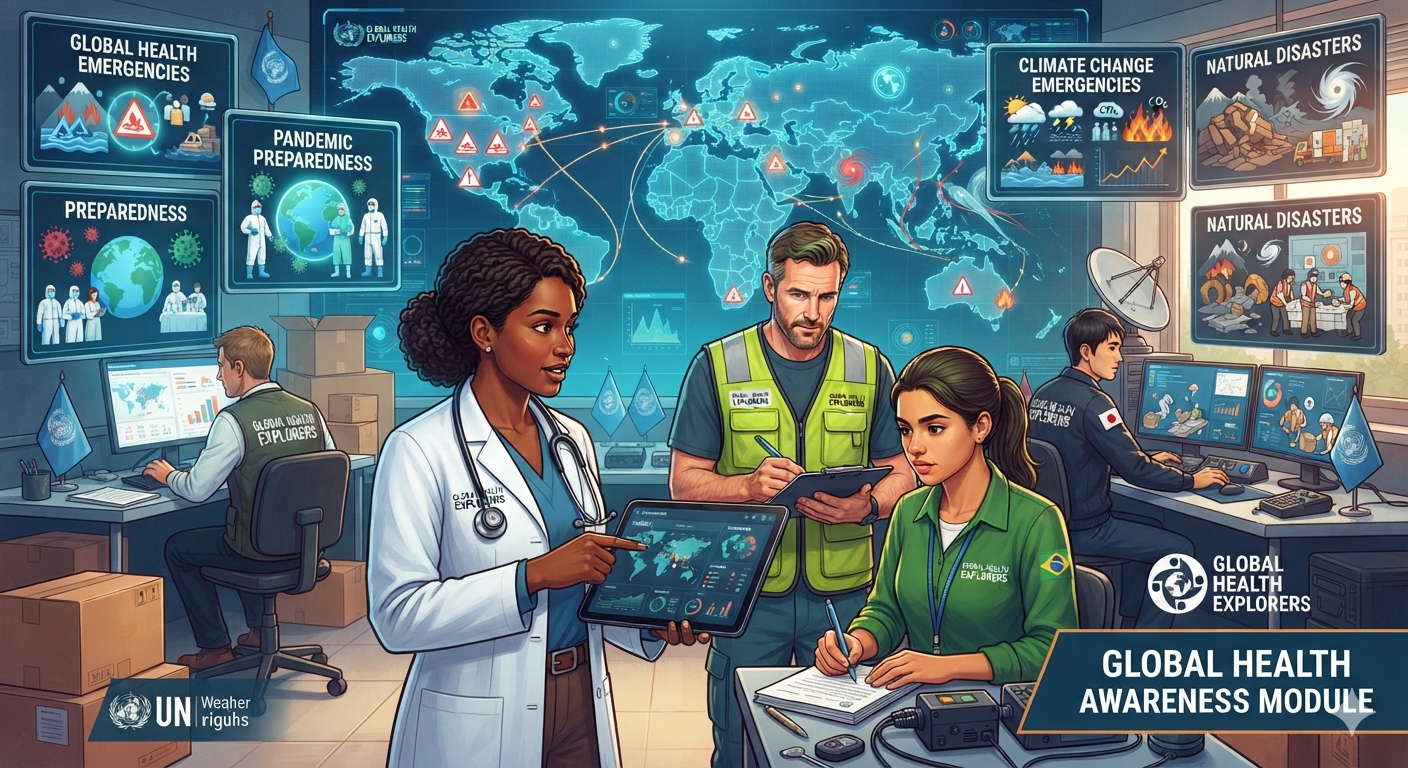
TRUSTED PUBLIC-HEALTH INFORMATION

Know where to look.

GHE teaches learners how to think critically about information—but GHE is not the authority that announces public-health emergencies or gives official public-health instructions.

PRIMARY AUTHORITIES

WHO & Government Public-Health Authorities

For current health threats, alerts, recommendations and official measures, go directly to the World Health Organization and the relevant government or public-health authority.

WHO Headquarters, Regional Offices and Country Offices may provide global and regional information, while governments and their public-health authorities make and implement decisions within their jurisdictions.

LEARNING EXTENSION

Learn more—but know the difference.

Educational resources can help learners understand epidemiology, global health and public-health concepts.

GHE may connect learners with educational resources such as NextGenU, but educational resources are not substitutes for current official public-health decisions.

THE GHE QUESTION

How does the world recognize and respond to a health threat?

And once a trusted public-health authority announces a public-health threat, what should I know and do?

UNDERSTAND

Recognize the system.

Surveillance, assessment, communication, coordination and response help societies understand changing health risks.

PARTICIPATE

Know your role.

Your role changes with the situation—but responsible participation always begins with reliable information, respect, appropriate action and care for others.

BEGIN YOUR JOURNEY

01 — Our Interconnected World

Start by discovering how people, environments, cultures and health are connected across our world.

Begin →