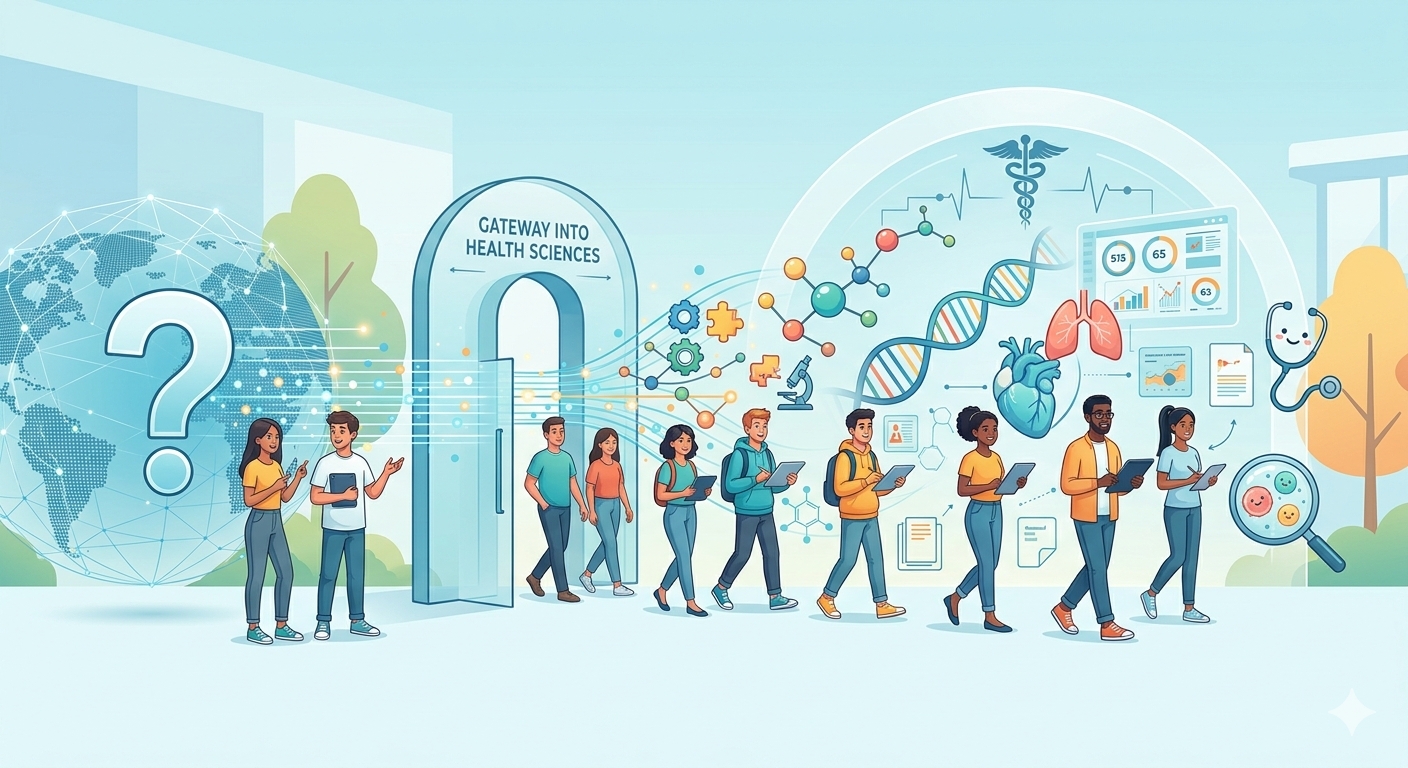
A practical guide for health researchers
A broad introduction that begins with the research question and moves through study design, research conduct, methods and communicating results, with ethics placed at the forefront.
Explore the WHO guide ↗Every meaningful investigation begins with a question.
Learn how questions become evidence, how evidence can inform action, and how one health question can open many pathways into research.
Build Your Mini-Proposal →Research is a systematic way of asking questions, gathering and examining evidence, and developing knowledge that can help us understand problems and make better decisions.
In health sciences, research can help us measure health problems, understand their causes and determinants, develop or improve solutions, translate evidence into policy and practice, and evaluate whether an intervention or programme works.
A strong research question gives your investigation direction. It helps you decide what evidence you need, who or what you need to study, and which methods may be appropriate.
Finding evidence is only part of research. We also need to understand how evidence was produced, how strong it is, what its limitations are, and whether it can help answer our particular question.
That means learning to distinguish an interesting claim from a well-supported finding — and learning to communicate uncertainty responsibly.
There is no single way to investigate a health problem. Different questions call for different research traditions — and sometimes several approaches can work together.
These fields are not isolated boxes. A single project may draw on several of them, depending on the question, context and evidence needed.
Evidence can be convincing — yet a programme, policy or intervention may still work differently in the real world.
Implementation research asks how health interventions, programmes and policies are put into practice, what helps or hinders implementation, and how context influences what happens.
For young researchers, it offers a powerful way to connect evidence with action: not only asking “Does this work?” but also “How can this work here, for these people, in this setting?”
You do not have to become an expert before you begin. These resources can help you build research literacy step by step.
A broad introduction that begins with the research question and moves through study design, research conduct, methods and communicating results, with ethics placed at the forefront.
Explore the WHO guide ↗Peters, Tran and Adam's WHO practical guide introduces implementation research concepts, language and opportunities, including material intended for newcomers.
Explore the WHO resource ↗NIH provides research training and educational opportunities across stages of education, with resources spanning biomedical, behavioural, social and clinical research.
Explore NIH training ↗CIHR supports health research training through awards, training platforms and other initiatives that help develop the next generation of researchers.
Explore CIHR training ↗A beginner-level course covering research questions, quantitative and qualitative studies, literature reviews, critical appraisal and scientific skills. You can browse the course for free.
Explore NextGenU ↗Health research can involve people, personal information, biological materials or sensitive questions. Young researchers should never independently collect or use human-participant data simply because a project is educational.