Know Your Risks
Learn which factors can increase or reduce the chance of illness or injury.
Prevention is about understanding risk, strengthening protection, acting early, and creating conditions in which people and communities can stay healthier.
GHE Principle: Prevention is not about preventing everything. It is about using knowledge, evidence and collective action to reduce avoidable harm and improve health.
You have already explored how to understand your body, protect yourself, reduce hazards and recognize when screening may help. Prevention brings these ideas together and asks a bigger question:
Prevention can happen before disease or injury begins, when a problem is detected early, or after a condition develops to reduce complications. It can also happen far beyond the individual — through families, schools, communities, health systems, policies and global action.
Instead of asking only, “How do we treat illness?”, prevention asks:
Prevention can reduce the chance that a problem occurs, help identify some conditions earlier, or reduce complications after a condition has developed.
Prevention does not require perfection. It often begins with practical, sustainable actions and knowing when to seek reliable information or support.
Learn which factors can increase or reduce the chance of illness or injury.
Build protective habits, relationships, environments and supports.
Do not wait for a problem to become more serious before asking a trusted adult or health professional for help.
Be cautious about health claims online. Ask where the information came from and whether credible evidence supports it.
Prevention can protect other people as well as you — especially when health risks are shared.
Health is influenced by many circumstances. Prevention should support people, not blame them for factors they cannot control.
Prevention is much broader than avoiding illness. Explore the ideas that public health uses to understand and reduce risk.
Characteristics, exposures, behaviours or circumstances associated with a greater likelihood of a health problem.
Conditions, behaviours, relationships and resources that can support health and reduce vulnerability.
Taking appropriate action before a problem grows or when early detection can improve outcomes.
Policies, services, environments and social conditions that make healthier choices and safer living more possible.
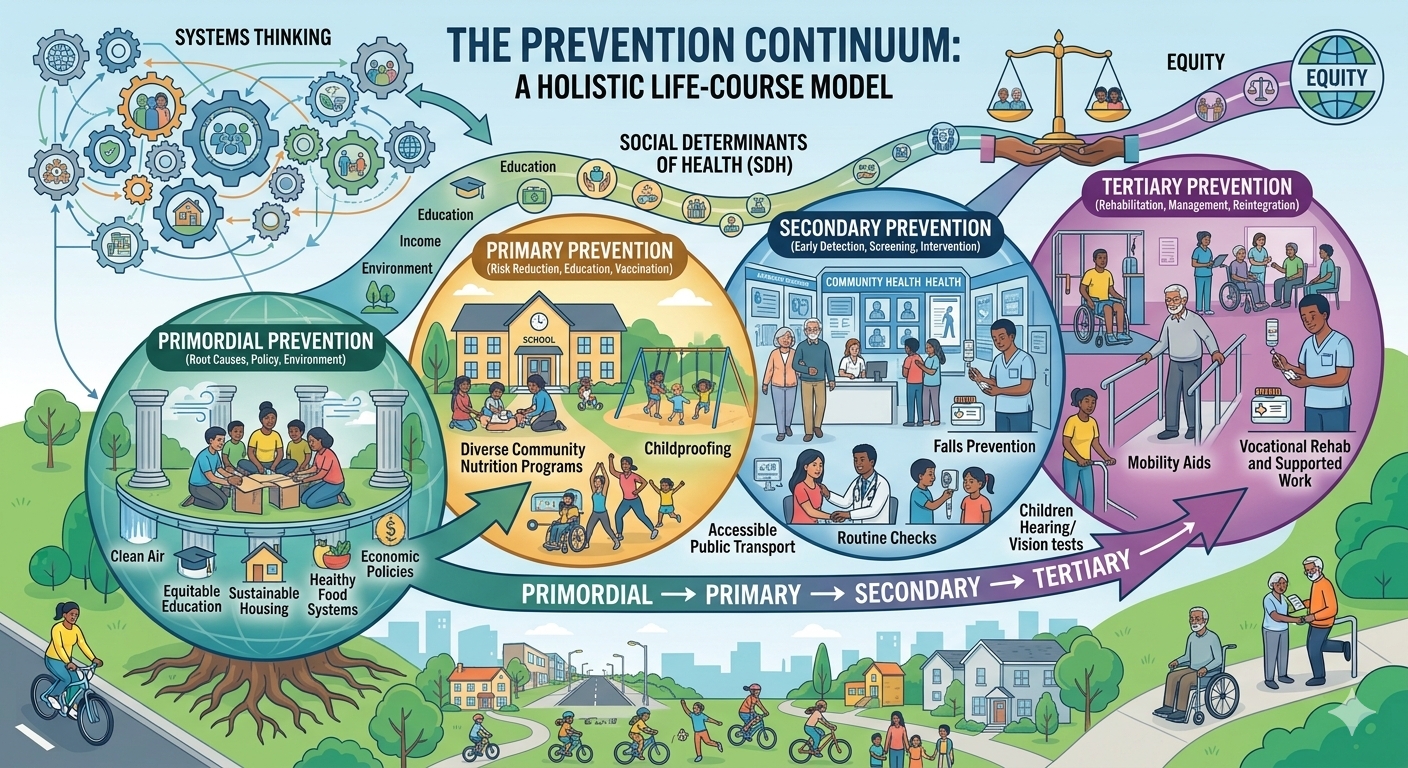
Public health commonly describes prevention across three levels. They are related, but they answer different questions.
Primary prevention aims to reduce the occurrence of disease or injury before it develops.
Secondary prevention aims to detect disease or risk early, when appropriate action may reduce harm.
Tertiary prevention focuses on reducing complications, disability or further harm after a condition has developed.
Screening is one possible form of secondary prevention, but not every screening test is appropriate for every person. Decisions about screening depend on evidence, age, risk, benefits, harms and context.
Individual actions matter, but people do not make health decisions in isolation. The environments around us shape what is possible.
Knowledge, skills, habits and decisions.
Relationships, support, norms and shared expectations.
Schools, neighbourhoods, recreation, transportation and local services.
Prevention, primary care, vaccination, screening and health education.
Laws, regulations, public investment and healthy public policy.
International cooperation, shared threats, evidence and global health action.
No. Some risks cannot be completely eliminated. Good prevention focuses on what can reasonably be reduced, controlled or supported.
Individuals are not the only actors. Families, schools, communities, governments and health systems also influence risk.
Blaming people can hide the social and environmental conditions that shape health. Prevention should increase opportunity, support and agency.
We need evidence. Strong prevention uses research, data, evaluation and attention to unintended effects.
Prevention becomes more powerful when we connect personal action with the systems and environments around us.
Learn, protect yourself, use reliable information and seek help appropriately.
Share accurate information, encourage safety and create supportive relationships.
Safer schools, healthier environments, accessible services and inclusive communities.
Build policies, services and environments that make prevention possible and equitable.
Work across borders on shared health threats, knowledge, equity and sustainable development.
Where people live, learn, work and grow can shape their opportunities for health. Prevention therefore requires attention to the social determinants of health.
Access to learning and health literacy can influence opportunities and decisions.
Safe homes and neighbourhoods can reduce exposure to preventable hazards.
Access to nutritious food is shaped by availability, affordability and environment.
Air, water, climate and the built environment influence health risks and opportunities.
Prevention depends partly on whether people can access appropriate health services.
Prevention should reduce unfair and avoidable differences in health.
If a prevention strategy works only for people who already have resources, information and access, we should ask whether it is truly equitable.
Prevention contributes to several Sustainable Development Goals because health is connected to education, equity, environment, cities and international cooperation.
Prevent disease, promote health and improve access to appropriate services.
Health literacy and education strengthen people's ability to make informed decisions.
Prevention should address unfair differences in health opportunities and outcomes.
Safe, inclusive and healthy environments are important prevention tools.
Climate action can reduce environmental risks that affect human health.
Prevention increasingly requires collaboration across sectors, disciplines and countries.
A prevention idea may sound convincing and still be ineffective. Evidence helps us distinguish promising action from unsupported claims.
What problem are we trying to prevent?
What causes or increases the risk?
What does credible evidence show?
Which intervention is appropriate?
Did it work, for whom and under what conditions?
Leadership does not mean having all the answers. It means asking good questions, checking evidence, listening to communities, identifying practical solutions and helping turn knowledge into responsible action.
Choose one health issue that matters to you. Think like a young public-health investigator.
What health problem would you like to prevent?
What are the risk and protective factors?
Who else influences this problem?
What realistic, evidence-informed action could make a difference?
You do not have to solve a global health problem by yourself. A responsible first step is often to learn, ask questions, involve trusted people, and identify what can realistically be changed.
GHE connects young learners with authoritative institutions and open educational resources. These resources can help you explore prevention from scientific, public-health, Canadian and global perspectives.
Practical evidence-based prevention strategies and preventive care.
Explore CDC → NIH Disease Prevention ToolkitEvidence-based information on screening, vaccines, infection prevention and other protective strategies.
Explore NIH → HARVARD Preventative CarePublic-health research and evidence on prevention, screening and health promotion.
Explore Harvard →Canadian resources covering children and adolescents, healthy eating, physical activity, mental health, oral health and other prevention topics.
Explore Canada.ca → U OF T What Is Public Health?An accessible introduction to population health, disease and injury prevention, education, policy and research.
Explore U of T → U OF T Health PromotionExplore health promotion through social determinants, community development, advocacy, policy and evidence.
Explore U of T →This course introduces the population approach to prevention, health promotion, social and cultural determinants, policy settings, and evaluation.
Use trusted resources to learn — but keep asking questions. A reliable source should help you understand the evidence, not simply tell you what to think.
Learn what matters, question what you hear, protect yourself and others, and help build healthier communities.