01
Recognize Hazards
A hazard is something that can contribute to harm. Learning to notice hazards is an important first step in prevention.
Injuries can happen at home, at school, during physical activity, while travelling, or in other everyday settings. Injury prevention helps us recognize hazards, understand risk, make thoughtful choices, and contribute to safer environments for ourselves and others.
Prevention begins with awareness. Understanding how injuries happen can help us reduce avoidable risks and build safer environments.
Personal care is not only about what we do for ourselves. It also includes recognizing hazards, preparing for everyday situations, protecting ourselves and others, and helping create safer homes, schools, communities, and environments.
Injury prevention is about understanding hazards, identifying situations that increase risk, and taking reasonable steps to make everyday activities safer.
A hazard is something that can contribute to harm. Learning to notice hazards is an important first step in prevention.
Risk can change depending on the person, activity, environment, equipment, and circumstances.
Prevention is stronger when individuals, families, schools, communities, and systems work together.
Many injuries occur in ordinary environments. Prevention therefore begins with everyday awareness rather than waiting for something to go wrong.
Take a moment to notice your surroundings before starting an activity.
Ask whether equipment, surroundings, and instructions are appropriate for the activity.
Tell a trusted person when you notice a hazard or feel uncertain about safety.
Knowing what to do before an emergency can make it easier to respond calmly and responsibly.
Injury prevention becomes easier to understand when we examine different environments and activities.
Explore how the design and organization of everyday spaces can influence safety.
Think about classrooms, laboratories, playgrounds, sports, and shared spaces.
Safe participation includes preparation, appropriate equipment, and understanding the activity.
Transportation safety involves people, vehicles, infrastructure, and decisions.
Different environments create different hazards and require different prevention approaches.
Preparedness can help individuals and communities respond more effectively when unexpected events occur.
An injury may be influenced by individual behaviour, the environment, equipment, infrastructure, social conditions, or several factors together.
The same activity can carry different levels of risk depending on where, when, how, and by whom it is performed.
Individuals can make safer choices, while families, schools, communities, governments, and organizations can improve environments and systems.
A safer environment is rarely created by one person alone. Prevention often depends on cooperation, communication, design, policy, and evidence.
Recognizing uncertainty and seeking appropriate guidance is a responsible safety behaviour.
Good prevention asks not only “What happened?” but also “Why was this situation possible?”
Identify hazards before acting.
Consider practical ways to reduce risk.
Think beyond yourself and consider others.
Look for reliable information rather than assumptions.
What looks like a personal safety decision can also be connected to family practices, community design, public policy, and global action.
Notice hazards, understand risk, and make responsible choices.
Share safety knowledge and communicate when something seems unsafe.
Think about schools, recreation spaces, roads, housing, and public environments.
Policies, standards, infrastructure, education, and public health programs can reduce risk.
Injury prevention is a global health issue influenced by inequality, infrastructure, education, and access.
People do not experience the same risks or have the same opportunities to prevent injury. Conditions in which people live, learn, work, travel, and grow matter.
Safe, stable housing can influence exposure to hazards and opportunities for prevention.
Knowledge and safety education can influence awareness, confidence, and decision-making.
Roads, public transport, vehicles, and infrastructure all influence injury risk.
Physical environments can either reduce or increase hazards.
Prevention and timely support depend partly on access to appropriate services and information.
Effective prevention should consider who is most exposed to risk and who has the fewest resources to reduce it.
Injury prevention should not place all responsibility on individuals. Good design, safe infrastructure, clear information, appropriate standards, and effective policies can make safer choices easier.
This is an important global health lesson: prevention is both personal and structural.
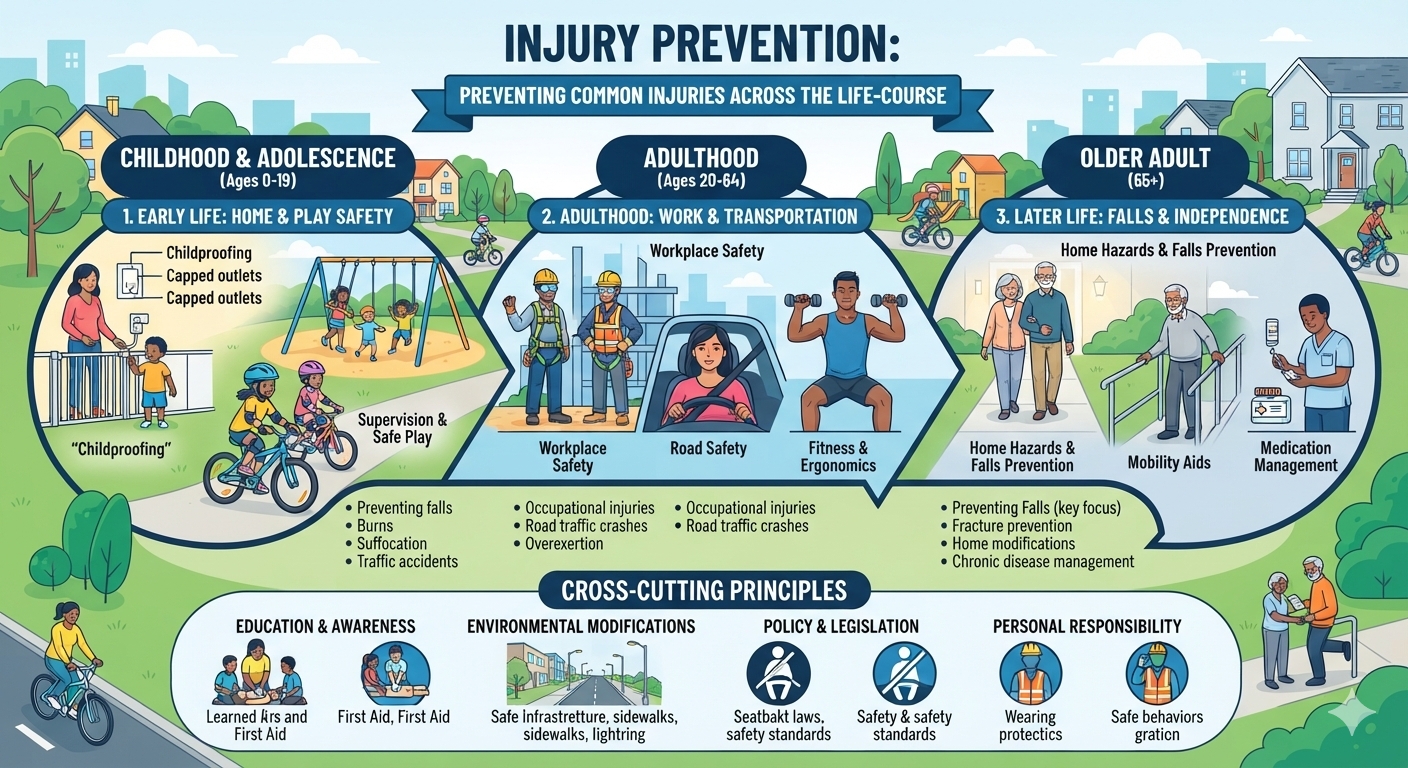
Prevention contributes to healthier and safer lives.
Safety knowledge and health literacy support informed action.
Prevention should consider different exposures, vulnerabilities, and opportunities.
Prevention should address unequal exposure to hazards and unequal access to protection.
Safer communities depend on thoughtful planning, infrastructure, and public spaces.
Strong systems, standards, accountability, and responsible governance support public safety.
Global health leaders use evidence to understand problems, identify preventable risks, design solutions, and consider equity.
What hazards or patterns are visible?
What reliable evidence helps explain the problem?
What could make people, places, or systems safer?
Would the proposed solution help everyone fairly?
Look around a familiar environment and identify one situation where safety could be improved. Then ask: What simple change could make this place safer?
What hazards do you notice more easily now?
What factors can make the same activity more or less risky?
How can prevention involve people beyond yourself?
What evidence would you want before proposing a solution?
Choose one realistic prevention action. It could be learning more, sharing reliable safety information, identifying a hazard, improving an environment, or encouraging others to think about prevention.