01
Connect
Supportive relationships can provide belonging, encouragement and practical help.
Mental health knowledge becomes meaningful when it helps us connect, support one another, seek appropriate help and act with compassion and evidence.
This is Step 5—the final page of the core GHE Mental Health pathway. You can return to any previous step at any time.
Understand the foundations.
Understand common conditions.
Discover what supports wellbeing.
Explore risk and inequality.
Turn knowledge into action.
Resilience is the capacity to adapt, recover and continue developing in the face of challenges. It is influenced by personal skills, relationships, resources and environments.
Supportive relationships can provide belonging, encouragement and practical help.
Flexible thinking, problem-solving and healthy coping strategies can help people respond to challenges.
Reaching out is not failure. Knowing when and where to seek appropriate support is an important life skill.
No single strategy works for everyone. Healthy coping involves finding approaches that are safe, realistic and appropriate to the situation.
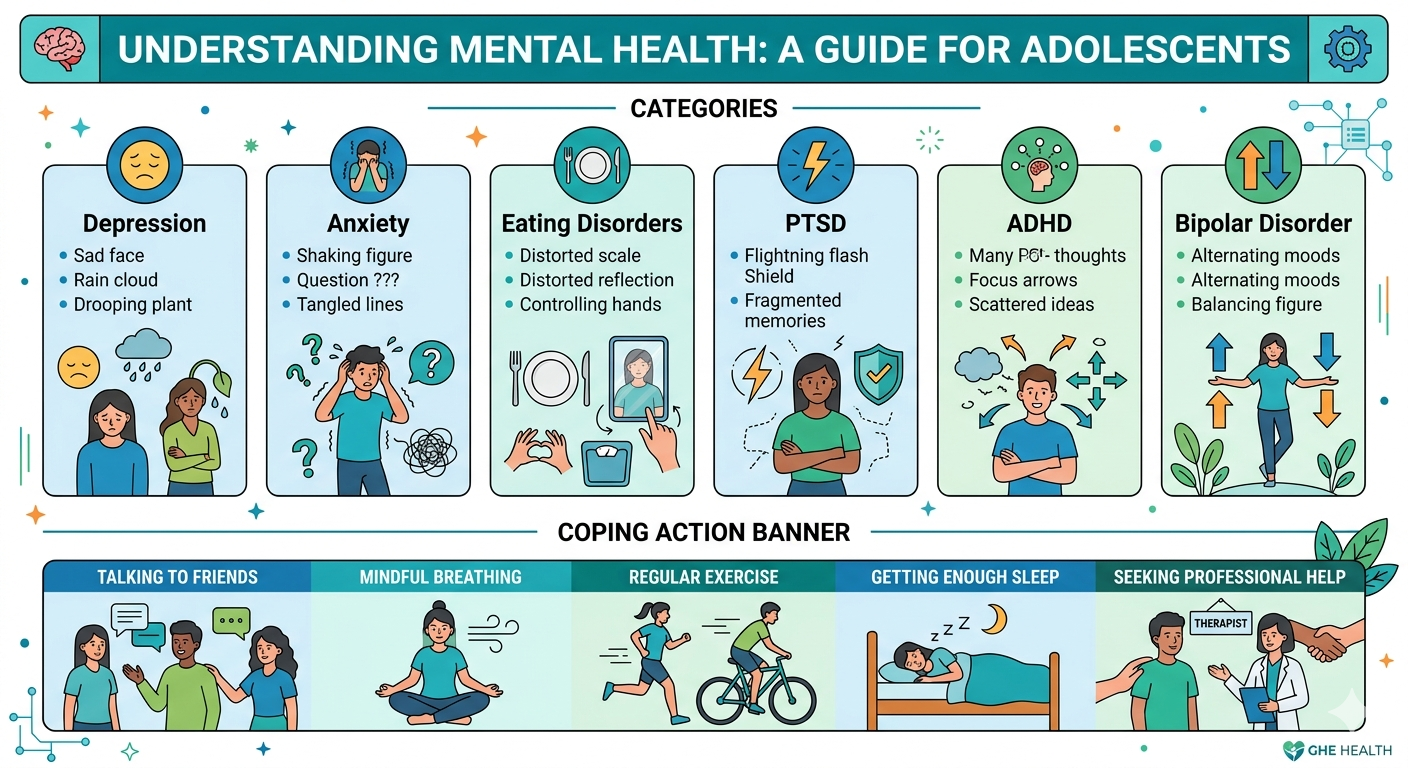
A trusted friend, family member, teacher or other trusted adult can provide connection and perspective.
Simple breathing or attention exercises can help some people pause and reconnect with the present moment.
Regular physical activity supports overall physical and mental wellbeing.
Consistent sleep routines can support learning, mood and everyday functioning.
Maintaining supportive relationships can reduce isolation and strengthen belonging.
When difficulties persist or interfere with daily life, talking with an appropriate professional can be an important next step.
People do not need to solve every mental-health challenge alone. A trusted adult, teacher, school counsellor, family member, healthcare professional or appropriate community service may be able to help.
Supporting a friend does not mean becoming their therapist. Listen, care and help connect them with appropriate support.
Healthy routines, coping skills, self-awareness and knowing when to ask for help.
Listening, friendship, communication, belonging and supportive relationships.
Schools, community organizations, recreation and accessible mental-health services.
Equitable health systems, education, social protection, policies and public-health programs.
Global cooperation, peace, human rights, climate action and reduction of inequalities.
Psychological tools can help us understand wellbeing, personality, experiences and symptoms. But a questionnaire is only one piece of information.
Some tools explore personality, strengths, wellbeing or other aspects of individual differences.
Some validated questionnaires are designed to identify symptoms that may warrant further attention.
Good measurement requires attention to reliability, validity, context, culture and purpose.
Personality is different from mental illness. The Big Five model describes broad dimensions of individual differences in personality.
It can be useful for learning about personality and self-understanding, but it is not a diagnostic test for mental health conditions.
Explore the Big Five Inventory →NextGenU's Introduction to Psychology includes a dedicated Personality module covering the Big Five model and a learning activity involving a Big Five personality test and critical reflection on the results.
Explore Introduction to Psychology →Does the tool produce reasonably consistent results?
Does it actually measure what it claims to measure?
Is the tool appropriate for this population, culture, setting and purpose?
What should—and should not—be concluded from the result?
A questionnaire can provide useful information. It should not automatically be used to diagnose yourself or someone else.
GHE connects learners with established organizations and educational resources. These organizations provide information and pathways to appropriate support.
Youth-focused mental health and wellbeing resources in British Columbia.
Visit Foundry →National mental-health knowledge, resources and initiatives.
Visit MHCC →Evidence-informed information and education about mental health and mental health conditions.
Visit CAMH →Mental health promotion, education and community resources across Canada.
Visit CMHA →A Canadian resource providing information and support for young people.
Visit Kids Help Phone →Mental wellbeing and appropriate support are essential to health.
Support should be accessible regardless of background or circumstance.
Health literacy and supportive learning environments matter.
Safety, rights and responsive institutions support wellbeing.
Correct answer: B. The capacity to adapt, recover and continue developing when facing challenges.
Correct answer: C. No. Resilience does not eliminate difficulties.
Correct answer: A. Listen respectfully and help connect the person with an appropriate trusted adult or professional when needed.
Correct answer: D. A questionnaire does not automatically establish a diagnosis.
Correct answer: B. Broad dimensions of individual differences in personality.
Correct answer: A. No. It is a personality framework, not a diagnostic test for mental-health conditions.
Correct answer: C. Whether a tool measures what it claims to measure.
Correct answer: D. Psychological concepts and measurement can be influenced by cultural and social context.
Correct answer: B. Persistent difficulties or changes that affect wellbeing, relationships, learning or daily functioning may warrant appropriate professional support.
Correct answer: A. Use tools to learn and understand—not to label or self-diagnose.
Mental-health leadership begins with respectful, evidence-informed action.
Replace myths with evidence.
Respect people's experiences.
Challenge stigma and exclusion.
Help people find appropriate support.
Help build healthier and more equitable communities.
But learning does not end here. Revisit any step, explore trusted resources, and continue learning about mental health throughout the life course.